Thursday, 15 April 2010
Friday, 2 April 2010
Thursday, 1 April 2010
Wednesday, 31 March 2010
u can see the film click on the like comment what u think about the film
to day we went and watch this film GATTCA
i like the piont of view of how the new world and how men try to create the perfect man
finger testing kit
Monday, 29 March 2010
blood head

i love this hed made by Mark Quinn i like the way this aretist use his own blood to make up his hed it shows the level that some 1 will go thou for his wark

this painting was don in 1474 by Ginevro de Benci
there are Other prominent artists who painted with their fingers include Albrecht Dürer (1471-1528); Giovanni Bellini (1430-1516); Pieter Bruegel the Elder (1525-69) (see "Digital Analysis 'Fingerprints' Artists," Scientific American, 23 November 2004); Cornelius Ketel (1548-1616), Piero della Francesca (1410-1492); Michelangelo (1475-1564); Goya (1746-1828); Degas (1834-1917); Jackson Pollock (1912-1956); and Francis Bacon (1909-1992). These fingerprints might provide good "exemplars" (samples) for authentication. (Kirsh and Levinson, p. 134.)

One of the Gavrinis Island slabs with fingerprint-like carving image.
flowting fingers
i found this home decoration google. this was made from finger printthis was created by Rigel Celeste
RADIAL LOOPS
A Radial Loop PatternThe distinction between Ulnar and Radial loops depends on which hand the loop is found on. In the image at left the core pattern area (noted in red) tends to come in from the left and go back out the left. Hold your left hand up to the screen and note that your little finger is on the left, which is the direction that the pattern tends to come in from and go back out to. Since this is towards your little finger, and by virtue of that towards your Ulnar bone in your arm, this makes the loop an Ulnar loop.Now, if you were to place your right hand up to the screen and make the same comparison you would find that the pattern area now tends to come in and go out towards your thumb. It so happens that the radial bone in your arm is on your thumb side so now this loop would be considered a radial loop.Obviously to make the distinction between these two types of loops you have to know on which hand they appear because if a loop pattern is an Ulnar loop on the right hand, then by default it will be a Radial loop if found on the left hand.Radial loops are not very common. Most of the time if you find a radial loop on a person it will usually be on the index fingers.
type of finger print
Whorls, on the other hand, are more complex. A whorl is always characterized by at least two deltas (and whorls with more than two are specifically called accidental whorls). The key to a true whorl is that an imaginary line drawn from delta to delta intersects a whorl line. What follows are some variations of whorls:


we as people are catigorize in different finger print grops as u can see the are five main finger print grops this can also be use as a barcode
Friday, 26 March 2010
DNA TESTING
DNA, or Deoxyribonucleic acid, is the molecule inside the cell’s nucleus that contains the genetic coding that will determine a human’s physical traits such as eye color, hair color, stature, bone density and all other traits. DNA is a long polymer that contains all the chemical information known as genes inside the nucleus. As the cells of the body divide, these DNA are replicated and are given to new cells so that each and every cell of the human body will have the exact DNA.
The genetic coding found in DNA is unique to every individual. Even identical twins have slightly different DNA coding from each other. These variations in the genetic information that is stored in DNA can be useful in identifying people or distinguishing one person from another. The use of genetic coding to determine identity is known as DNA testing. There are a lot of ways that DNA testing can help in today’s society.
Below: this graphlike series of bars is the common visual image seen from a DNA test. Bars and their placement are all coded as computer data very precisely and can be compared to millions of other DNA profiles in only a few moments.

DNA paternity testing, for example, had helped parents to determine who the real father of a child is, if that is in question. Today, there are even home DNA test kits that can determine the genealogy of a person. People nowadays even go for dog DNA tests to settle disputes over which neighbor's pet got another's pet knocked up.
Another way of using this genetic coding is through forensic DNA testing. Crime scene investigators use this test to find the identity of a person through the use of human body parts (hair, chipped nails, saliva or skin) that were left at a crime scene. The DNA test results are almost always accurate enough to convict a suspect.blood groupe test
Home Blood Group and Rhesus Test
This is a simple, one-step test to identify your blood group easily and accurately.The Blood Group Test can be carried out at home and detects common blood groupings (A, B, O, AB and Rhesus).
Two tests are included so that a family member or friend can also have their blood group tested

i like the wave and tune that Vanessa with her work using her own blood

venessa is a trough artist that will go the length to get the outcome that she wont in her work
this painting was don by using her own menstrual blood instead of paint. How did she collect the blood? With a moon cup throughout 36 periods.
BAD BLOOD PAINTING

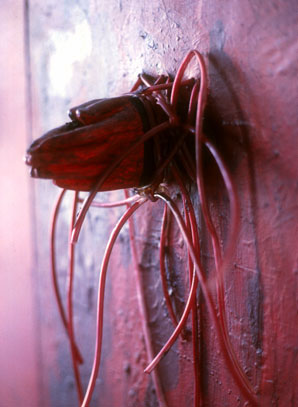
These painting combine praying plaster hands firmly attached to canvas by intravenous plastic feeding tubes.
The canvas, hands and tubes are aggressively covered with crimson red oil paint.
The paintings were inspired by the shortage and possible contamination of blood supplies, amplified by the AIDS epidemic.
i like the way the tubes rap around the hand it explain what the artist is show the sorrow that people with aids and other terminal illness go though every day
click on image to see the label
1 of my ideas was to create a miniature sculpture of me and then cut out all the vessels in a humans body to show the passing of blood in the body.
After looking back at brief i found out that creating this didn't show anything about me so I am going to look at a different idea that will represent me more.
Thursday, 25 March 2010
how to take ur blood test at home
Instructions for use.
Read the entire instructions before carrying out the test. Ensure the applicators (eldonsticks) are only used for stirring and spreading the blood. You may find this test easier to carry out if you have a friend or family member assist you.
- Wash your hands before carrying out the test and again after carrying out the test.
- Open the foil pouch containing the test cards, the 2 tests are on the one card so you need to cut the tests into 2 single cards. Using a pair of scissors cut the cards in half, down the line in the middle of the two. Place the card on a table or flat surface.
- Lay out the applicators (eldonsticks) ready for use.
- Fill a small cup with tap water and using the plastic pipette, draw a small volume of the tap water into the plastic pipette. You draw the water by simply holding the small, thin end in the water and squeezing the top part.
- With the test card still on a flat surface release one drop of water onto the coloured dry material inside the first circle (Anti-A). Continue dropping a small drop of water into each of the other 3 circles.
- Wipe a fingertip with the alcohol impregnated tissue provided and allow it to dry.
- Remove the small protective cap from the end of the lancet
- Place the lancet against the end of the finger and press the button in one quick movement.
- Place a drop of blood on the tip of an eldonstick, the drop should cover the whole circular surface of the eldonstick. Massage the finger from the bottom to the top to encourage bloodflow.

- Place the eldonstick with the drop of blood into the first circle (Anti-A). The blood should touch the water already present. Gently press the side of the eldonstick head against the card and stir in the water and blood mixture until the coloured dry material has dissolved.

- Repeat this procedure for the other 3 circles, making sure you use a new eldonstick for each circle. You should NEVER transfer liquid from one circle to another.
- Once all 4 circles are complete gently tilt the whole card vertically on its bottom edge and keep this position for 10 seconds. You will see the blood flowing slowly to the bottom of the circle. Repeat this procedure tilting the card on the 3 other sides.
- As soon as you have finished tilting read and record the results immediately. See the table below for how the results are interpreted.
Blood Group Test Instructions
How accurate is this test?
The test is accurate and will detect the common blood grouping system A,B,O,AB and Rhesus(D). Unusual blood groups or rare sub-types will not be detected by this method. Further investigation by a blood transfusion laboratory will be necessary to identify such groups.
Please note : This test should not be used to determine blood type for transfusion purposes.
Test contents:
- Instruction leaflet
- Blood group test card x 2 (inside foil pouch)
- Blood group result card x 2
- Lancets X 2
- Plastic pipette
- Alcohol swab x 2
- Applicators x 8, 4 for each test.
Precautions
- Each card can only be used once
- Do not use this test if the foil pouch has been opened
- Perform test at room temperature
blood
In vertebrates, it is composed of blood cells suspended in a liquid called blood plasma. Plasma, which comprises 55% of blood fluid, is mostly water 90% by volume, and contains dissolved proteins, glucose, mineral ions, hormones, carbon dioxide (plasma being the main medium for excretory product transportation), platelets and blood cells themselves. The blood cells present in blood are mainly red blood cells (also called RBCs or erythrocytes) and white blood cells, including leukocytes and platelets. The most abundant cells in vertebrate blood are red blood cells. These contain hemoglobin, an iron-containing protein, which facilitates transportation of oxygen by reversibly binding to this respiratory gas and greatly increasing its solubility in blood. In contrast, carbon dioxide is almost entirely transported extracellularly dissolved in plasma as bicarbonate ion.
Vertebrate blood is bright red when its hemoglobin is oxygenated. Some animals, such as crustaceans and mollusks, use hemocyanin to carry oxygen, instead of hemoglobin. Insects and some molluscs use a fluid called hemolymph instead of blood, the difference being that hemolymph is not contained in a closed circulatory system. In most insects, this "blood" does not contain oxygen-carrying molecules such as hemoglobin because their bodies are small enough for their tracheal system to suffice for supplying oxygen.
Jawed vertebrates have an adaptive immune system, based largely on white blood cells. White blood cells help to resist infections and parasites. Platelets are important in the clotting of blood. Arthropods, using hemolymph, have hemocytes as part of their immune system.
Blood is circulated around the body through blood vessels by the pumping action of the heart. In animals with lungs, arterial blood carries oxygen from inhaled air to the tissues of the body, and venous blood carries carbon dioxide, a waste product of metabolism produced by cells, from the tissues to the lungs to be exhaled.


the diogram show me what is in ur blood from this i was thinkin to do a double helix from all the different things that is in ur blood